Back And Spine Asanas
Admin 2 - atnews
By Ashwini Guruji
“You are as young, as straight is your spine" – Yogi Ashwini
The practice of Sanatan Kriya, eight-limbed path of yoga, also called Ashtang Yoga, re-introduces a person to nature and balance, body’s harmonious relationship with surroundings and self. The power of Yoga lies not in the movements but in stillness.
Sanatan kriya, as taught at various Dhyan Foundation centres, helps a practitioner attain that state of stillness from which creation emerged - the true state of Yoga, thereby enabling him to manifest his thoughts in his body and the environment.
A prerequisite for Yoga, is a strong spine. Spine, often called the second brain, controls reflexes in the body. Any kink in the vertebral column, prevents free flow of prana resulting in congestion and hence disease.
For the seekers of Yoga, here is a seven-step guide to a straight, strong and supple spine.
Preparatory Position - Lie flat on the stomach, legs straight, heels together and in sleeping position, forehead and chin resting on the floor. This is the preparatory position, from which you move into each of the seven asans.
Each asan is to be repeated seven times, before moving to the next. The eyes remain shut and internal awareness is maintained.
1. SARPASANA – “snake pose” - Interlock your fingers and place the hands on the hips. Take a deep breath, stretch your arms backwards and raise your spine, shoulders and chest, keeping the head (facing down) parallel to the ground.
Hold this posture for a count of seven. Exhaling, gently release and come down. People with heart conditions and high blood pressure must not strain while performing this asan.
2. ADVASANA – “reversed corpse pose” - Place your palms onto the floor with arms stretched forward. Hold this posture for a count of seven pushing the abdomen into the floor. Breath follows natural rhythmic pattern, eyes are shut, awareness on the breath and the spinal column.
3. JYESTIKASANA – “superior posture” - Interlock your fingers and place the palms onto the lower neck. Stretch and push the elbows into the ground. Hold this posture for a count of seven, maintaining natural rhythmic breath.
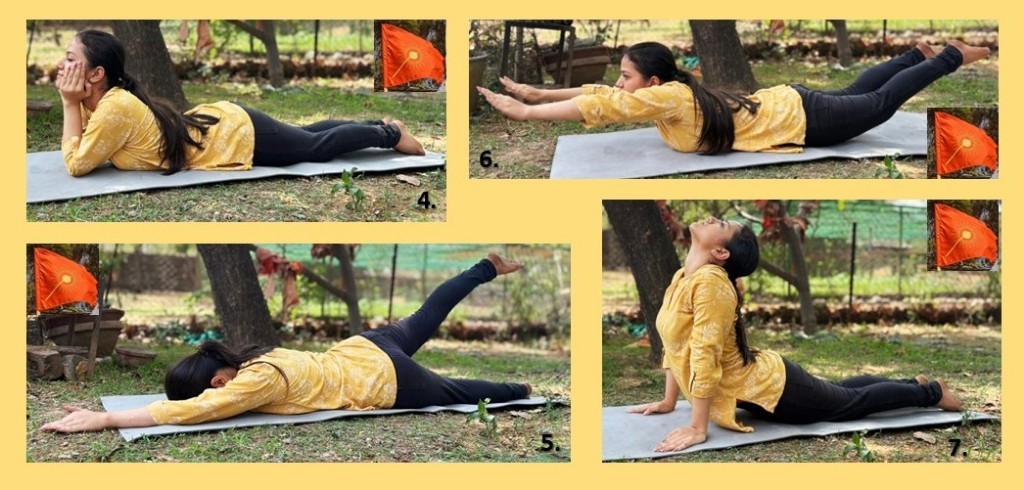
4. MAKARASANA – “crocodile pose” - Cup your chin with your palms, resting your elbows on the ground. When the elbows are stretched out and arms flat on the ground, tension is felt in the neck. If the elbows are drawn to close to the chest, tension is felt in lower back.
Keep the elbows at a comfortable distance such that the two points are equally balanced and the whole spine is relaxed. Hold this posture for a count of seven, maintaining natural rhythmic breath.
5. ARDHA SHALABHASANA – “half locust pose” - Place the right hand straight above the head and the left hand downwards, both the palms lying flat on the ground. Take a deep breath and then raise your left leg straight off the ground.
Forehead and arms remained fixed to the ground. Hold for seven counts. Exhaling, gently release and bring the leg down. Repeat the same with the opposite leg and hands.
6. YAANASAN – “airplane pose” - Place the arms straight above the head, palms resting on the floor. Inhale and then raise the legs upward and arms together without bending knees and elbows. Head is also raised, parallel to the ground. Hold this posture for a count of seven. Exhaling, come down gently.
7. BHUJANGASAN – “cobra pose” - Place your elbows close to the waist, the palms facing downwards next to the shoulders. Inhale. Gently raise your forehead, followed by the neck, the shoulders, and the upper and middle back such that the naval rests on the ground.
Gently tilt the head backward such that the chin is pointing forward. The elbows are raised slightly off the ground. Hold this posture. Exhaling return- starting in the reverse order, head coming down the last.
People suffering from peptic ulcer, hernia, intestinal tuberculosis or hyperthyroidism must not practice this without expert guidance.
Regular and correct practice of the above seven steps encourages the vertebral column to resume its natural shape and releases compression of the spinal nerves thereby strengthening the spine.
These asans are extremely beneficial for those with slipped disc, stiff neck and stooping figure. They are also recommended in conditions of cervical spondylitis, sciatica, lower back pain or any other spinal disorder.
A word of caution here, these asans must be strictly done under the supervision and guidance of your Guru. An unsupervised incorrect practice of these may cause irreversible damage to the body.
*) Ashwini Guruji is the Guiding Light of Dhyan Foundation and an authority on the Vedic Sciences. His book, 'Sanatan Kriya, The Ageless Dimension' is an acclaimed thesis on anti-ageing.
Since 2024, Dhyan Foundation volunteers in Indonesia have been teaching Sanatan Kriya at weekly sessions in Lombok and monthly sessions in Bali, all free of cost as per the Guru-Shishya Parampara. For more information you can write to dhyan@dhyanfoundation.com or log onto www.dhyanfoundation.com
Baca Artikel Menarik Lainnya : Kemendagri Gelar KMF Cegah Ancaman Pemilu 2019