Nyepi Day, New Year of Hindu, Vasudhaiva Kutumbakam
Admin 2 - atnews
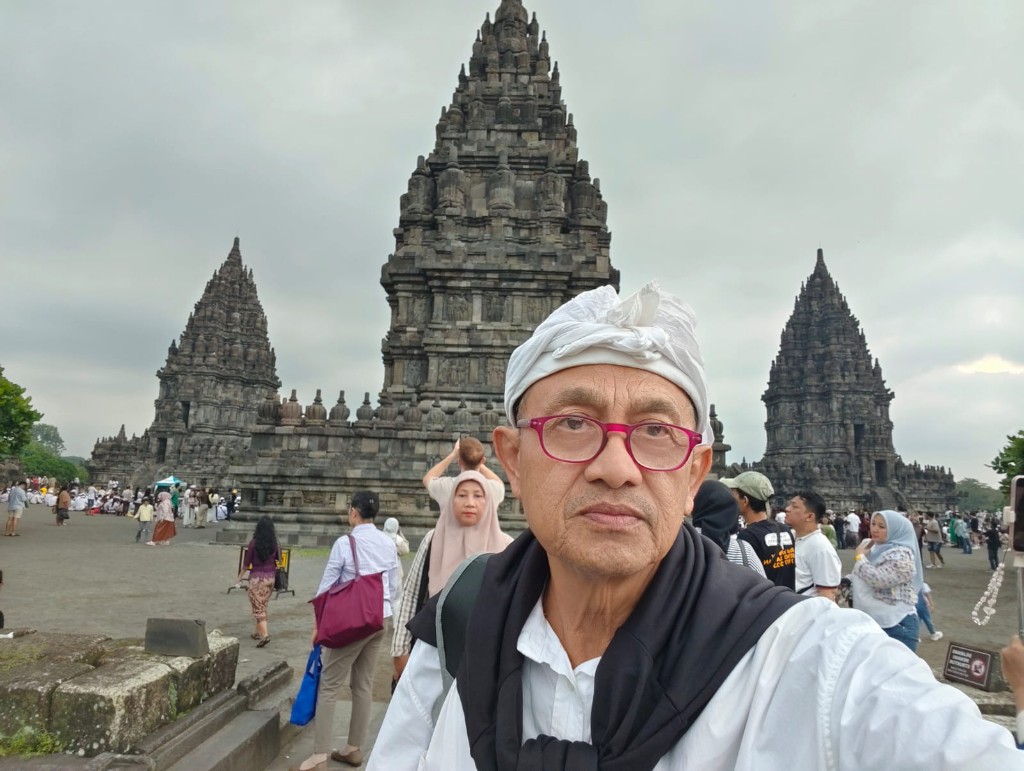
Denpasar (Atnews) - Global traveler and humanist Putu Suasta stated that Nyepi Holiday of Saka Year 1948/2026 is a meaningful moment for Hindus to celebrate spiritual consolidation based on Sanatana Dharma.
Sanatana Dharma is not limited to a single book. Rather, it encompasses thousands of years of tradition, thought and knowledge. Hinduism is capable of adapting. “That is the uniqueness of the eternal culture of Sanatana Dharma as a way of life,” said Putu Suasta, an alumnus of Gadjah Mada University and Cornell University, in Denpasar on Wednesday (March 18).
This year, Nyepi Day falls on Thursday (March 19). That day, according to the Hindu lunar calendar, is also the Hindu New Year, called Hindu Nav Varsha, marking the beginning of a new year.
Therefore, this new year will begin on March 19, 2026, the pratipata tithi or new beginning of the shukla paksha or New Moon in the month of Chaitra. That day will be Vikram Samvat 2083. In Hinduism, this day is very important because it is believed that the Creator of the universe, Lord Brahma, began the creation of the universe on this day.
This special day is also celebrated by different names in different regions of India (Bharat). It is celebrated by various names, each with its own unique name and rituals, such as Nav Varsh, Nava Samvatsara, Gudi Padwa, Poila Boisakh, Chaitra Navratri, Yugadi, Ugadi, Cheti Chand, and others.
People welcome the new year as a new beginning and offer prayers according to their rituals and traditions.
Vikram Samvat is one of the oldest Hindu calendars, and according to it, North Indians celebrate Navratri, welcoming Goddess Durga. It is believed to bring wealth, vitality, prosperity, and joy. This day is also considered very auspicious for starting new business ventures, new endeavors, and setting goals.
The Vikram Samvat, also known as the Vikrami calendar, is a historical calendar for Hindus in India. Similarly, it is the official calendar of Nepal and is named after King Vikramaditya. This calendar began to gain prominence after the 9th century with the beginning of epigraphic artwork. Before the 9th century, the same calendar system was known by other names such as Krita and Malava.
Meanwhile, the Saka Era marks the beginning of Saka Samvat, the historical Hindu calendar that was later introduced as the 'National Calendar of India' in 1957.
The Saka Era is believed to have been established by King Shalivanhana of the Shatavahana dynasty. The Saka calendar consists of 365 days and 12 months, similar in structure to the Gregorian calendar. The first month of Saka Samvat is Chaitra, which begins on March 22, which coincides with March 21 in leap years. The 12 months of the Saka calendar consist of: Chhaitra, Vaishakha, Jyeshtha, Ashadha, Shravana, Bhaadra, Ashwin, Kartika, Agrahayana, Pausha, Magha, and Phalguna.
The Saka calendar is also used by Indonesian Hindus in Bali and Java. Historically, Nyepi commemorates the Saka New Year, which began in 78 AD in India, when King Kanishka I successfully united warring tribes. This calendar was brought to the archipelago by traders and priests from India.
The Majapahit Empire adopted the Saka calendar system, originating from ancient India, as its official calendar. Records from the Negara Kertagama indicate the celebration of the Saka New Year (Caitramasa) in the Majapahit Empire, where the new moon day of Tilem (the new moon) of that month was considered sacred for the purification of Buana Alit (humans or microcosm) and Buana Agung (nature or macrocosm). When Majapahit conquered Bali in the 14th century, the Saka culture and calendar system were brought with them, thus establishing the Nyepi celebration in Bali.
In Bali, the Saka New Year is celebrated with the Catur Brata Penyepian (not lighting fires, not working, not traveling, not seeking entertainment). The practice of self-isolation and not leaving the house has been a part of Balinese local wisdom since long before Hinduism arrived in Bali. Therefore, several villages in Bali are known for observing the ancient tradition of Nyepi Desa (limited to that village). Some villages that still practice this tradition include Sebatu Customary Village in Gianyar, Ababi Customary Village in Karangasem, Kusamba Village in Klungkung (Nyepi Segara or prohibition of going to sea), Banyuning Village, Pedawa Village, and Cempaga Village in Buleleng. The arrival of Hinduism in Bali strengthened the theological foundation of this deep-rooted practice.
The Hindu Dharma Council of Indonesia (PHDI) held the National Dharma Santi 2026 as the culmination of Nyepi celebrations this year. The event carries the theme “Vasudhaiva Kutumbakam: Harmonious Nusantara, Advanced Indonesia.”
Previously, the Mahashivaratri Prambanan Shiva Festival 2026 was successfully held at Prambanan Temple, which is recognized by UNESCO as a World Heritage Site.
The National Dharma Santi Celebration 2026 will again be held in Bali on April 17, 2026, emphasizing unity and harmony in diversity as one global family.
Building togetherness and tolerance is a challenge today and in the future amidst technological advances and the influence of globalization. Moreover, there is still war in the Middle East due to the Israeli/United States (US) attack on Iran since February 28, 2026.
However, the war between Russia and Ukraine has not ended. Meanwhile, war has begun between America, Israel, and Iran.
Disputes throughout the world continue, and wars continue as a sign of Kali Yuga. This indicates that people have forgotten compassion and the reality that humans may seem different, but we are all one (Vasudhaiava Kutumbakam).
History is late in recording that the modern era saw the World War I (WWI), leading to the establishment of the League of Nations. But it failed. Then, the World War II occurred. This should not have happened again, so the UN was established. But now, look at the situation. It is in place, ineffective. The ongoing wars continue.
During the Dvapara Yuga (Age of Doubt), there was also a great 18-day war known as the Mahābhārata. The Mahābhārata literally means “History of India.” Mahā means great, and the history of India is great. Bharata means India.
Original name of India is Bharata-varsa. You probably know it. Bharata-varsa. The entire planet was originally known as Ilavra-varsa. Then, there was a king, Maharaja Bharata. So, true to his name, the entire planet became Bharata-varsa. The entire planet is called Bharata-varsa according to the Vedic literature. But now the planet is divided.
There is a long history of how human societies spread across the planet Earth. According to the Mahabharata, the Americans, or Europeans, originated in India (Bharatavarsa).
The Turkic and Greek civilizations originally originated in India. Two sons of Maharaja Yayati were given the Turkic and Greek kingdoms, and from the Turkic and Greek kingdoms, the European civilization or population developed, and from Europe, the Americans came here. Of course, that is a historical point.
The Vedas state that nations throughout the world were once classified not by race or ethnicity, but by spirituality.
From a spiritual and conscious perspective, the nations of the Vedic period were divided into two major groups: the Aryans and the Mleccas.
The Aryans possessed a high spiritual civilization. They were not distinguished by race or ancestry; any race or ancestry that adhered to religious principles was considered Aryan. The main characteristic of the Aryans was the presence of Brahmins and other religious leaders.
Meanwhile, the Mleccas lacked religious principles. They did not follow saints and prohibited sacrificial ceremonies. Most of the Mlecca kings were killed by the Avatars.
According to the physical characteristics and habitats of the nations, according to the Vedas (Mahabharata Purana and Srimad Bhagavatam Canto 11), the nation of the world began in the Treta Yuga.
It began with King Pururava, the originator of the Chandra Dynasty. King Pururawa had a famous son named Raja Ayu. King Ayu had 5 sons. The famous son was named Nahusa. King Nahusa had a son, famously named Yayati.
Descendants of Yayati gave birth to many warrior groups. Likewise, many of his descendants became Mlecca (not Aryan), which is a group (not a race) that does not follow saints and has no religion. Many of these knights were killed by Parasurama and the rest fled to various corners of the world, thus becoming the forerunners of various nations throughout the world today.
The knight was sanctified under the Maharaja Sagara dynasty with Rsi Aurwa. King Sagara performed Aswamedha which was also followed by Maharaja Yudisthira when Dwapara Yuga began to end.
It is also said, “O Vyāsadeva, you have composed a great literature, the Mahābhārata. And in that Mahābhārata you have introduced everything that can be known to be understood.” The Mahābhārata was originally written for women and strī-śūdra-dvija-bandhūnām (SB 1.4.25).
(Out of compassion, the great sage considered it wise that this would enable humans to attain the ultimate goal of life. So, he composed a great historical narrative called the Mahābhārata for women, laborers, and friends of the dwi-fag.)
Once there was only one flag, Bharatavarṣa, and its capital was Hastināpura. Gradually, the control of Pandavas declined. Until Mahārāja Parīkṣit, the entire world was Bharatavarṣa. Now, it has become a small landmass, a peninsula.
When Mahārāja Yudhiṣṭhira performed the yajña of horse sacrifice, the people of these countries also came to participate in the celebration, and they paid homage to the Emperor.
This part of the world is called Kimpuruṣa-varṣa, or sometimes called the Himalayan provinces (Himavatī). It is said that Śukadeva Gosvāmī was born in these Himalayan provinces and that he came to Bharata-varṣa after traversing the Himalayan countries.
In other words, Mahārāja Parīkṣit conquered the entire world. He conquered all the continents bordering all the seas and oceans in all directions, namely the eastern, western, northern, and southern parts of the world.
Indeed, during the reign of Emperor Yudhisthira or Sri Ramacandra, humans were free from all worries. There was even no extreme cold or heat.
On that account, the theme of the National Dharma Santi 2026 is highly relevant in rebuilding the awareness of Vasudhaiva Kutumbakam.
Suasta also explained that the series of Nyepi celebrations will repeat annually: melasti as a reminder of the sanctity of the gods by cleansing worship paraphernalia in the sea; pangerupukan as an effort to ensure that worshippers are not disturbed by any form of ghosts; Nyepi as the culmination of Mahahening (supreme silence); and ngembak geni as a joyous celebration of the close bonds of brotherhood between believers.
The rainy season, which occurred throughout the beginning of the year and into March 2026, remains an unresolved problem in this country, especially in major cities like Jakarta and several others. Floods and landslides are common occurrences in this country. In some ways, nature seems unfriendly, but we seem to be making no effort to learn from the past on similar issues.
This year, Nyepi celebration is also accompanied by political upheaval, corruption, and escalating ethnic and religious conflicts, such as those in Papua a few months ago. Likewise, there are alleged mega-corruption cases involving Pertamina state-owned energy giant, tin mining company, and others.
The alignment between the government and political parties, the dissenting observers, and the debates in electronic media never show maturity and wisdom. We feel like a country that is still standing still while other countries are rapidly catching up.
The current chaotic situation in the country seems to have thrown away the wisdom this nation once possessed; it has cast aside the conscience of national and state life, and it has abandoned the togetherness once shared by the founders of the nation. What now exists is a clamor and din of discourse that is far from practical. We are simply racing through heated conversations on electronic media, fueling insults, hatred, and slander, all of which are detrimental to peace, harmony, and cultural stability.
The rituals are so boisterous, the official ceremonies are limited to normative speeches, but afterward, there is still a commotion that brings neither functional nor spiritual benefits. The existence of the internet and its various communication products further exacerbates the commotion. Does this nation need a little silence to reflect inwardly?
Suasta, a life traveler, stated that Nyepi is the philosophy of the new year for Balinese Hindus. When the Saka New Year arrives, it is greeted by silence throughout Bali.
Balinese elders in the past formulated silence in lay terms through four stages of solitude, known as catur bhrata panyepian. Silence, broadly speaking, is something easily understood by those who follow the Dharma system. The four silences in question are: first, silence from bright things (amati geni). In lay terms, amati geni is understood as not turning on the lights at night. However, its meaning is far deeper than that. The silence of light allows us to focus our minds on trying to “go deeper within ourselves,” allowing us to “see the vast ocean” within our minds, helping us reach the gateway to our true selves. It is true that if we want to concentrate, we always close our eyes, do not we?
For a year, we are inseparable from our moving bodies, our five senses awake according to their respective functions, sweating wearily in the battle of work, everything moving, working, rumbling within us. And when Nyepi arrives, all the hustles and bustles of body and mind come to a halt, silent, still, and still. This is the most beautiful moment of amati karya, to feel the contraction of how the whole self, which has been so boisterous in motion, then ceases all activities. There is ancestral wisdom that creates the need for the body and mind to “feel” still, to gather the energy drained over almost a year, towards contemplative recovery.
A full Day of Silence in the third silence, known as amati lelungan, leads the spirit to experience the joy of a full day of inner wandering, a time the mind rarely gets to spend alone during the year. Connecting with the inner self, listening to the voice of the heart we have ignored, and experiencing a deeper spiritual peace are only possible when we empty ourselves of the steps of travel. Silence is a tapa bhrata of silence, where all that exists is the self and the “true self.”
How does it feel when physical pleasures are stopped for a day? This is what the silence of amati lelanguan offers. In the silence of lelanguan (entertainment), we are encouraged to draw closer with the truest entertainment within us, namely the song of the heart, the song of silence, even though we may not yet have reached the level of “listening” to the song of the heart or silence, at least all our senses can be rested from hedonistic entertainment. Even sensory entertainment can sometimes be tedious.
For Balinese elders of the past, Nyepi did not consider the economic benefits or losses, because, however they felt, there was a time when people needed silence to give them the opportunity to examine themselves fully in the journey of life that followed.
For those who were diligent in spiritual practices, Nyepi became the most beautiful time to practice tapa bharata (restraining all desires), yoga, and serious meditation. Because Nyepi was the most likely state for them to achieve, they believed in the complete silence that would help them on their spiritual path. However, for laypeople, the four paths described above should be adhered to according to the customary rules and regulations applicable during Nyepi Day.
In various understandings of tattwa (philosophy), the meaning of silence—or sunya—is understood to mean that silence is not always taken literally. Nothingness is not empty. Silence, in their understanding, is a state of silence that allows people to find enlightenment, a path to discovering complete awareness of the true self.
Achieving silence is a spiritual practice. Many sunya tattwa experts believe that a state of silence is the foundation of all self-awareness, which desires unification with the true self. And the path of silence is the most enabling condition for that. “So, the essence of sunya is the silence that is Unmanifest.”
In sunya, all existences have lost their identity, and all that exists is essence. Therefore, practicing sunya is a spiritual practice to create a space of silence within oneself as a total awareness that is no longer trapped by attributes and self-identities that shackle and create a thick wall of rigidity and diminish the purity of the Atma. Thus, the essence of achieving súnya is an effort to delve into oneself, thus arriving at an experience where everything is perceived equally and in the same perspective.
Indeed, the path to the true self is a spiritual struggle for humanity to attain the ultimate happiness, a truly transcendental purity. Often, not only is the effort to find the true self, but even reconstructing the inner “quiet space” is not necessarily easy. The strong influence of worldliness often binds humanity to delve into itself, to discover the essence of the “Unmanifest” self.
As stated in the Bhagavad Gita, Chapter IV, Verse 4, “For those whose minds are focused on the Manifest, the difficulty is greater, for truly the path of the Unmanifest is difficult for those with a physical body to reach.”
No matter how difficult the path to the True Self may be, the wise still lovingly guide their followers to the true self. This is likely why the Balinese ancestors decided to reconstruct Nyepi as a space of absolute silence to examine all deeds, actions, and words, to provide adequate contemplation for the masses.
Nyepi is a state consciously constructed to lead to a state of absolute silence. Hindus in the archipelago, especially in Bali, are then invited to engage in this silence. A state of silence has been generally provided, so if we are wise, this state can be a truly spiritual moment for understanding what is happening within and without ourselves.
Even in the conversation of Krishna with Arjuna on the Kurukshetra Battlefield, Bhagavad Gita verse 10.38 states, “maunaṁ caivāsmi guhyānāṁ” or “Of secrets, I am silence.”
Among secret activities such as listening, thinking, and meditation, silence is the most important because with silence one can make rapid progress. (GAB/001)

Baca Artikel Menarik Lainnya : Kemendagri Gelar KMF Cegah Ancaman Pemilu 2019